1. Summary
The phones in pockets are ready for Wi-Fi DAS. Taking 100 US handsets from 2010 to 2026 and weighting each by how many were sold and how long phones stay in use, 98% of the phones in US pockets in 2026 are ready for data over a Wi-Fi DAS — their operating system can join a Passpoint network — up from 50% in 2015 and 92% in 2021.1 88% are ready to carry voice over it too, because their carrier has enabled Wi-Fi Calling on the SKU it sells, up from 0% before 2016 and 72% in 2020.2 88% are ready for both and 2% for neither.3
How this compares to a legacy cellular DAS. A neutral-host DAS built at the 2011 LTE roll-out and upgraded at the typical venue pace (Track B) still serves almost every one of those phones — 97–100% attach and get voice and data through it in every year — but the share of the phones' usable spectrum it passes narrows from 94–100% through 2017 to 79–86% from 2021 to 2026 (81% in 2026).1 A never-upgraded 2011 plant passes 18% of that spectrum by 2026; a continuously upgraded one 98%.1 Wi-Fi DAS data readiness overtook the typical legacy cellular DAS's spectrum match in 2020 (2019–2021 across every sensitivity case), and voice readiness overtook it in 2024 (2021–2025 across the market-weighted cases; there is no crossing if the 100 phones are weighted equally, §9).4
The two readiness numbers come from different layers. Data readiness is OS capability (measured; venue enablement is not observable). Voice readiness is carrier enablement, documented per device on carrier and OEM support pages, and its gap is a policy artefact rather than a hardware one: every device that fails the voice test after 2016 is an unlocked or retail SKU on a carrier that whitelists its own builds (AT&T, formerly Sprint), while carrier-sold builds of the same phones have Wi-Fi Calling.2
95% of phones two years old or newer in 2026 are ready for both data and voice over Wi-Fi.Phone lifetime does the rest. Every device in the cohort released from 2016 onward is ready for data, and voice readiness rises with recency: 95% of phones two years old or newer in 2026 are ready for both, against 79% of older phones.3 With US handset lives of 3–4 years, the voice gap is a trailing-cohort effect that the phones in pockets are already working through.
For a venue the picture in 2026 is therefore complementary, not either/or. A Wi-Fi DAS can carry data for 98% of the phones in pockets and voice for 88%; the legacy cellular DAS carries voice for the remaining 12% and legacy-band data for everyone, at four-fifths of the spectrum modern phones are built for. Together the two give 99% of phones a voice path and 100% a data path.3
The vendors' own datasheets and FCC grants date the DAS lag at every wave (passive plant 698–2700 MHz until 2018–2020; full B66 modules 2018–2024; C-band DAS modules 2021–2024), and half the installed base carried B66 by 2019, B71 by 2020, n77 by 2023.56
2. Question and scope
Year by year, 2011–2026: what share of the phones in US pockets is ready for a Wi-Fi DAS — data through Passpoint, voice through Wi-Fi Calling — and how does that compare with how well the installed legacy cellular DAS base, under realistic upgrade behaviour, matches the bands the same phones are built for? Where do the curves cross? Scope, tiers and rules follow the plan (das-vs-passpoint-handset-analysis-plan.md v2) and CLAUDE.md: per-band splits are never collapsed (B12 ≠ B13 ≠ B17; B4 ≠ AWS-3 paired ≠ full B66; LTE B41 ≠ NR n41); a DAS passes spectrum, not technology; conflicts are logged, not resolved; every fact carries a URL.
3. Method
Handset cohort. 100 US-SKU devices, 20 per era (2010–12, 2013–15, 2016–19, 2020–23, 2024–26), selected from comScore and Kantar US best-seller lists and Counterpoint global best-seller lists where available and by archetype (flagship / mid / prepaid) otherwise (cohort_selection.csv, column selection_source). Bands per US SKU from GSMArena's per-variant lines, Apple tech-spec pages for iPhones, frequencycheck per-model pages where GSMArena merges variants, and FCC equipment-authorization grants in QA (95 of 100 devices carry a resolved FCC ID).7 Seven band flags were flipped in adjudication where an FCC grant contradicted the Tier-2 value (conflicts_log.md C-adj-01).
DAS capability. das_timeline.csv gives, for each year and each of three tracks, the bands a plant passes and the technologies the carriers still transmit. Track A = never upgraded; Track B = typical venue (2–3 year lag for module adds, 3–5 years or forklift for out-of-passband spectrum, calibrated on FirstNet B14 and C-band); Track C = actively maintained (vendor state of the art plus one procurement cycle).8 Track-C and Track-B dates were re-set in September 2026 against 321 dated vendor rows — Wayback datasheet revisions and FCC grants for Corning/MobileAccess, CommScope/Andrew, TE/ADC FlexWave, SOLiD, ADRF and JMA/Teko (das_passband_evidence.csv; the timeline rows that rest on it are tagged [E] in das_timeline.csv).5
Scoring rule (scripts/score.py). For each device × year × track: native if the device has at least one usable LTE/NR band on the plant and every band in its preferred capacity layer (its n77, n41/B41, n71/B71, B66, B30, B14 as present) is fully passed; partial if at least one preferred layer is passed or partially passed; degraded if the device has a usable LTE/NR band on the plant (usable = fully passed) but none of its preferred layers; 3G/voice fallback if the device has no usable LTE/NR band, has 3G, and 3G is still transmitted (techs_served; ends 2022); unserved otherwise. NR on n2/n5/n25/n41/n66/n71 counts as passed when the plant passes the same-numbered LTE band (in-passband NR rides the LTE passband, the DSS/refarm case of rule 4). A 2011-era LTE phone whose bands are the plant's bands scores native. "AWS-3 paired blocks" passes B4 fully and B66 partially; "B14 (passive-only)" counts as partial; CBRS is excluded from the preferred set (a small-cell layer, not a DAS expectation).
Spectrum-match index (headline DAS metric). For each device × year × track: the share of the device's US downlink spectrum that the plant passes, with each band weighted by its 3GPP downlink width (MHz): B2 60 / B25 65, B4 45 / B66 90, B5 25 / B26 35, B12 17 / B17 12, B13 10, B14 10, B30 10, B41/n41 194 (TDD), B71/n71 35, n77 280 (US C-band). Supersets are counted once (B25⊃B2, B26⊃B5, B12⊃B17, B66⊃B4); LTE and NR on the same band are one block; a partially passed band counts half; "AWS-3 paired blocks" pass 70 of B66's 90 MHz; CBRS (B48) is excluded as a small-cell layer. The population value is the survival-weighted mean over LTE/NR-capable devices that support at least one band in the table. Band width is a proxy for capacity, not a measurement of it — carriers load their layers unequally (T-Mobile n41, Verizon/AT&T n77) — and "passes" still assumes the carrier feeds the band. Served = the device attaches and gets service on at least one live band (native + partial + degraded + 3G fallback).
Installed-base weighting. A device enters the population in its release year with a market weight and decays with an exponential survival curve of mean life 3.5 years (swept 3 and 5).9 The market weight is the device's estimated share of US smartphone sales in its launch window (the twelve months from release), scaled so the mean weight within each era is 1; it is constant across years, so the survival curve alone does the ageing.10 Weights come from a four-level hierarchy, best available evidence first: a published US all-market sales share for the model inside its launch window (35 devices: Counterpoint US top-5/top-10, Kantar); a US share carried from within two years, or a DeviceAtlas US traffic share converted to sales (2); a within-OEM model-mix share multiplied by the OEM's US share (13); and the OEM's US share split equally across the OEM's cohort devices in that era (50). Per-model evidence carries 69% of total weight, 70–85% in the eras from 2016 onward. All weight evidence is Tier 3 and changes weights only, never a device fact. The former equal-weights-within-era case is kept as the unweighted sensitivity (§9), and the OEM-share-only alternative as oemw.
Wi-Fi DAS: ready to carry voice (Wi-Fi Calling). For each of the 100 devices, Wi-Fi Calling enablement was established per US carrier from Tier-1 pages: Apple's per-carrier US feature page for iPhones; carrier per-device support pages (Verizon knowledge base, AT&T device-support capability records, T-Mobile device pages) and OEM articles (Google Pixel Help, Motorola carrier-compatibility articles) for Android; dated carrier launch statements (T-Mobile Un-carrier 7.0, Sept 2014; Sprint Apr 2014; AT&T Oct 2015 iPhone / 2016 Android; Verizon 2016). A device counts as voice-ready when every carrier its SKU is sold for lists it (single carrier for a carrier build, all three national carriers for unlocked/multi-carrier SKUs and iPhones); support is dated from the later of device release and carrier launch, with the first archived capture kept as an upper bound. Where a carrier cell was blank, community reports (Tier 3) together with the carrier's dated blanket statement could lift it to "probable", never "confirmed" (two cells). Coverage: 88 of 100 devices confirmed, 7 probable, 5 not found (qa/wfc_support_merged.csv).
Wi-Fi DAS: ready for data (Passpoint layers, from cohort columns): silicon (802.11n-or-later Wi-Fi, 2013+); OS-capable — iPhone from max(release, 2013); Android from release if launched on 6.0+ (11+ = required), release + 1 if capability arrived by update (assumption); certified — WFA Product Finder certificate date; enabled — not measurable, so the OS-capable curve is the upper bound and is labelled as such.
4. What the vendors' own documents say about DAS capability
The datasheet-diff pass (das_capability_timeline.md §7) pins the lags behind each handset wave:5
- Passive plant was specified 698–2700 MHz from at least January 2013 through May 2018 (CommScope), 650/690–2700 MHz at ADRF, and 698–2700 on TE's combiner shelf. That passband already contained FirstNet B14 and the PCS G block, so those refarms rode for free on passive plant; it did not contain B71 (617–698) or anything above 2.7 GHz. Sub-698 and above-2.7 GHz passives appear 2018-02 (ADRF 578–2700), 2019-07 (JMA 617–4200 antennas) and by 2020-01 (CommScope 555–6000; the transition is bracketed 2018-05 → 2020-01, C-CommScope-05). ADRF's passives still stop at 2700 MHz in 2026.
- Active remotes. B30 modules 2015 (TE, CommScope, Corning) to 2017 (SOLiD, ADRF). B41 modules 2015 at four vendors. AWS-3 arrived as paired blocks only (B4 + 1710–1780/2110–2180) from 2015 (JMA) to 2017 (TE, Corning, ADRF); full B66 (with the 1695–1710 / 2180–2200 extensions) first shipped December 2018 (JMA), then 2020 (CommScope), 2021 (Corning), 2023–24 (SOLiD); TE and ADRF never. Commercial FirstNet B14 modules 2016 (JMA) to 2020 (Corning); TE never. B71 modules 2018 (ADRF, JMA) to 2022 (CommScope). C-band n77 DAS modules 2021-10 (JMA), 2022 (SOLiD, ADRF, CommScope), 2024-05 (Corning, first granted >3 GHz module; "C-band ready" marketing from January 2021).
- Consequence for the model. Track C now adds B41 in 2015 (not 2013), carries "AWS-3 paired" rather than full B66 until 2019, gains B71 in 2019, and reaches n77 at four of six vendors by 2023 (Corning 2024-05; TE never); Track B carries AWS-3 paired blocks 2017–2020 and full B66 from 2021–22 (
proposed_track_c_diff.md, applied).8
5. The handset side: which bands the installed base carries
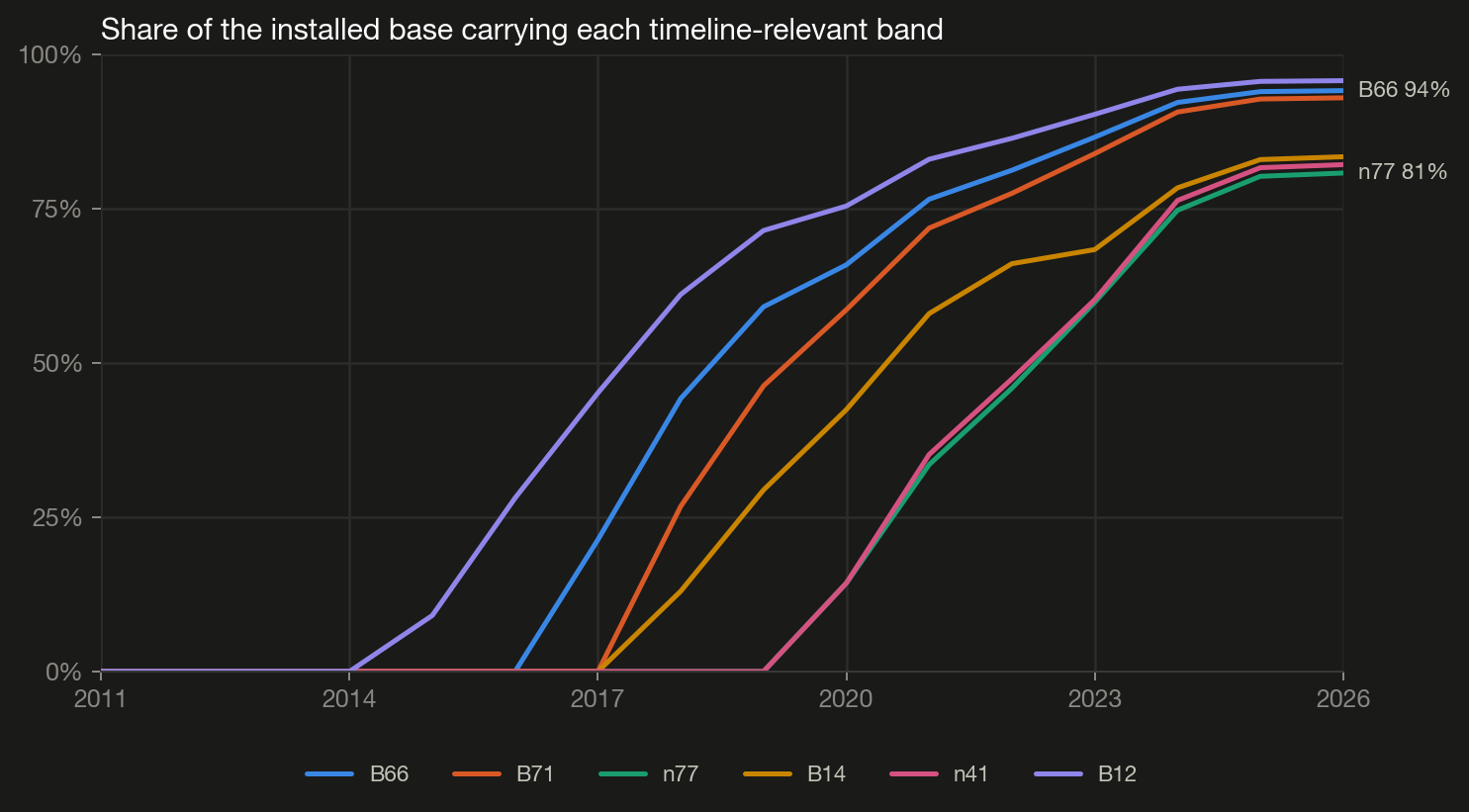
Weighted to the installed base, half the phones in use carried B12 in 2018 (45% in 2017), B66 in 2019, B71 in 2020, B14 in 2021, n41 and n77 in 2023; by 2026 B66 is in 94%, B71 in 93%, n77 in 81% of phones in use.6 Set against §4: full B66 reached a typical venue (Track B) in 2022, three years after half the phones carried it; n77 reached Track B only as "partial / flagship venues" from 2023; B71/n71 enters Track B in 2021–22 (P-B71, applied), four to five years after the 2017 launch. Handsets lead plant by two to five years at every wave, and the gap is widest exactly where carriers put capacity (n77, n41, n71).
6. How this compares: what a typical legacy cellular DAS delivers, by year
| Year | Spectrum match, Track A | Spectrum match, Track B | Spectrum match, Track C | Served, Track B | Passpoint OS-capable |
|---|---|---|---|---|---|
| 2011 | 100% | 100% | 100% | 100% | 0% |
| 2013 | 98% | 98% | 98% | 100% | 40% |
| 2015 | 93% | 96% | 97% | 100% | 50% |
| 2017 | 70% | 98% | 99% | 100% | 71% |
| 2019 | 48% | 92% | 100% | 100% | 85% |
| 2020 | 40% | 86% | 93% | 100% | 88% |
| 2021 | 33% | 80% | 86% | 100% | 92% |
| 2022 | 26% | 79% | 89% | 97% | 94% |
| 2023 | 21% | 85% | 98% | 98% | 96% |
| 2026 | 18% | 81% | 98% | 99% | 98% |
Source: analysis/curves.csv, scenario base.1 Three readings. (1) Through 2017 a typical plant carries essentially all the spectrum its phones can use — the 2011 bands were the phones' bands, and the 2013–2017 additions (B12, B25 G block, B41, AWS-3 paired blocks from 2017) were in-passband or module adds. (2) The decline from 2018 is the handset side outrunning the plant: B71 (2017 launch, in Track B from 2021–22), full B66 extensions (2018 vendor SOTA, Track B 2022), n77 (2022 macro, Track B partial from 2023). The 2021–2022 low (79–80%) is the window between the 5G bands reaching phones and reaching typical plant. (3) Track A shows what "never upgraded" costs: in 2026 a 2011 plant passes 18% of the installed base's usable spectrum (less for the newest phones), while still serving it. Track C shows the ceiling: 98% of the base's spectrum in 2026, with dips to 86–89% only in 2021–2022.
Secondary view — service state on Track B. The binary categories (native = all preferred capacity layers fully passed; partial = some; degraded = a usable LTE band but no preferred layer; 3G fallback; unserved) are kept for completeness. They exaggerate the DAS decline because a single missing layer (often AT&T's 10 MHz B30, which Track B never carries) moves a phone from native to partial.
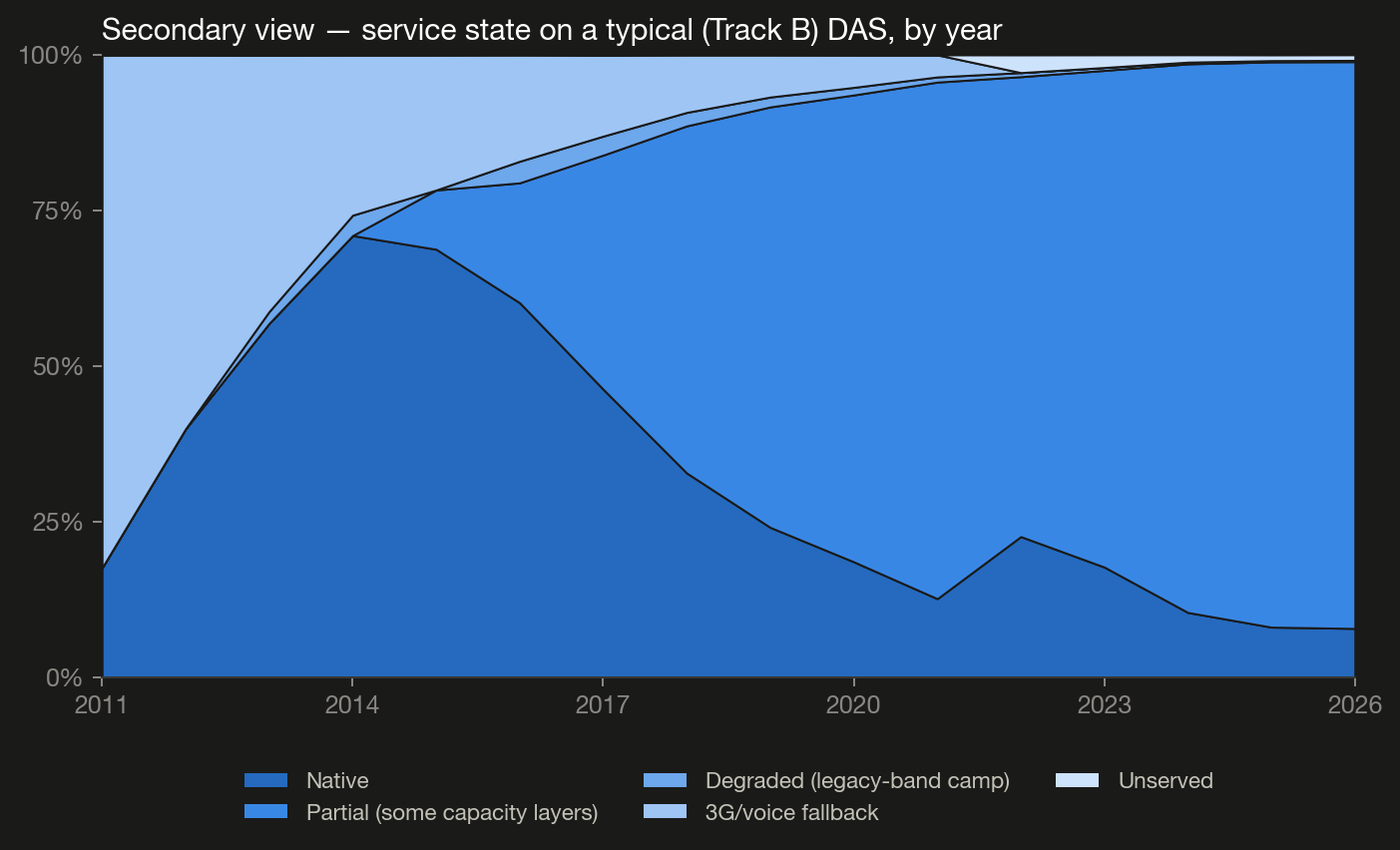
| Year | Native | Partial | Degraded | 3G fallback | Unserved |
|---|---|---|---|---|---|
| 2011 | 18% | 0% | 0% | 82% | 0% |
| 2013 | 57% | 0% | 2% | 41% | 0% |
| 2015 | 69% | 10% | 0% | 22% | 0% |
| 2017 | 46% | 38% | 3% | 13% | 0% |
| 2019 | 24% | 68% | 2% | 7% | 0% |
| 2021 | 13% | 83% | 1% | 4% | 0% |
| 2023 | 18% | 80% | 0% | 0% | 2% |
| 2026 | 8% | 91% | 0% | 0% | 1% |
7. Wi-Fi DAS readiness by ecosystem
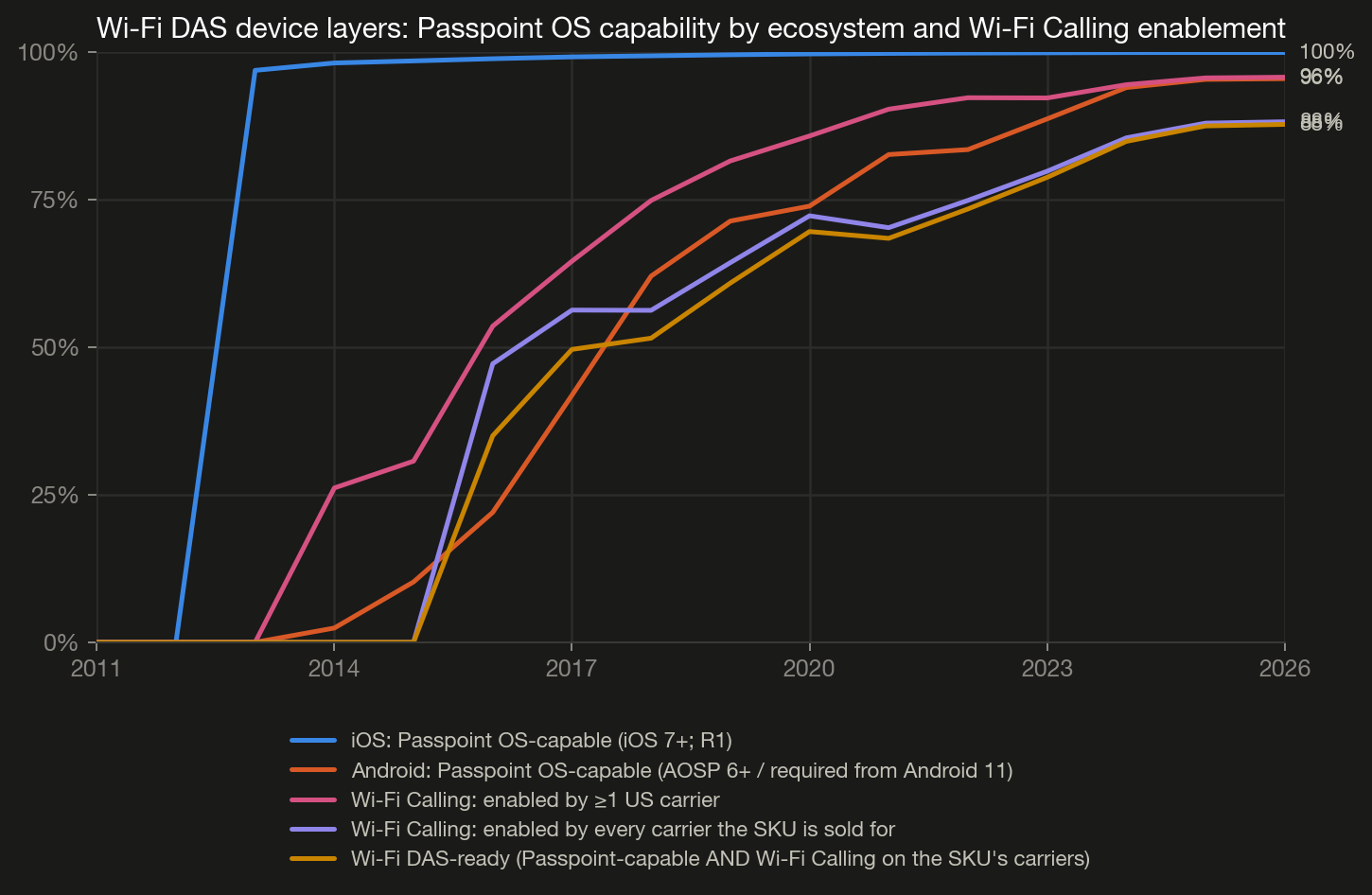
Ready for data (Passpoint). iOS is OS-capable from iOS 7 (2013): 97% of the iPhone installed base in 2013, 99% in 2015, 100% from 2020 — at Release 1, where Apple has stayed.11 Android arrives with Android 6 (2015) and becomes mandatory in Android 11 (2020): 10% of the Android base in 2015, 42% in 2017, 83% in 2021, 96% in 2026.1 Whether a venue or operator has pushed a Passpoint profile is not observable, so these are upper bounds. Wi-Fi Alliance certification was checked and set aside as a metric (7 of 69 Android devices, all 2013–2018; Apple does not certify).12
Ready to carry voice (Wi-Fi Calling). Carrier enablement is documented per device, so this layer is measured rather than bounded. On the strict test (every carrier the SKU is sold for), 0% of the installed base before 2016, 47% in 2016, 72% in 2020, 88% in 2026; on the loose test (any carrier), 96% in 2026.2 Every cohort device released from 2016 onward has a Wi-Fi Calling listing on at least one carrier; the strict shortfall is concentrated in unlocked and retail mid-tier SKUs (Moto G/E series, Galaxy A series, LG Tribute/Stylo, OnePlus) on carriers that whitelist their own builds — the carrier-sold sibling SKU of the same phone is enabled in every case found.2 Five devices remain unsourced.
Ready for both, by phone age. In 2026, 88% of the phones in pockets are ready for both data and voice over Wi-Fi DAS; 95% of phones two years old or newer, 79% of older phones.3 By release cohort, every 2016+ device is ready for data and 78–100% of each year's devices are ready for voice (2024 cohort: 9 of 11; 2025: 5 of 6).
What the legacy cellular DAS still does for voice. For the 12% of phones without Wi-Fi Calling on their carrier, the legacy cellular DAS remains the native voice path, and it serves them at legacy-band capacity; combining the two, 99% of phones in 2026 have a voice path.3
8. Crossover
Wi-Fi DAS data readiness overtakes the typical legacy cellular DAS's spectrum match in 2020 (Passpoint-capable 88% vs 86%), 2019–2021 across the sensitivity cases.14 Voice readiness crosses in 2024 (Wi-Fi Calling 85% vs 82%) and stands at 88% against 81% in 2026; the crossing falls in 2021–2025 in every market-weighted case and does not occur if the 100 phones are weighted equally (79% vs 82% in 2026), because equal weighting gives low-volume unlocked Android SKUs the same footprint as an iPhone (§9).24 Against a never-upgraded legacy cellular DAS (Track A, 18% spectrum match in 2026) both readiness curves crossed years ago (data 2017, voice 2018); against an actively maintained one (Track C, 98%) neither has.
9. Sensitivity
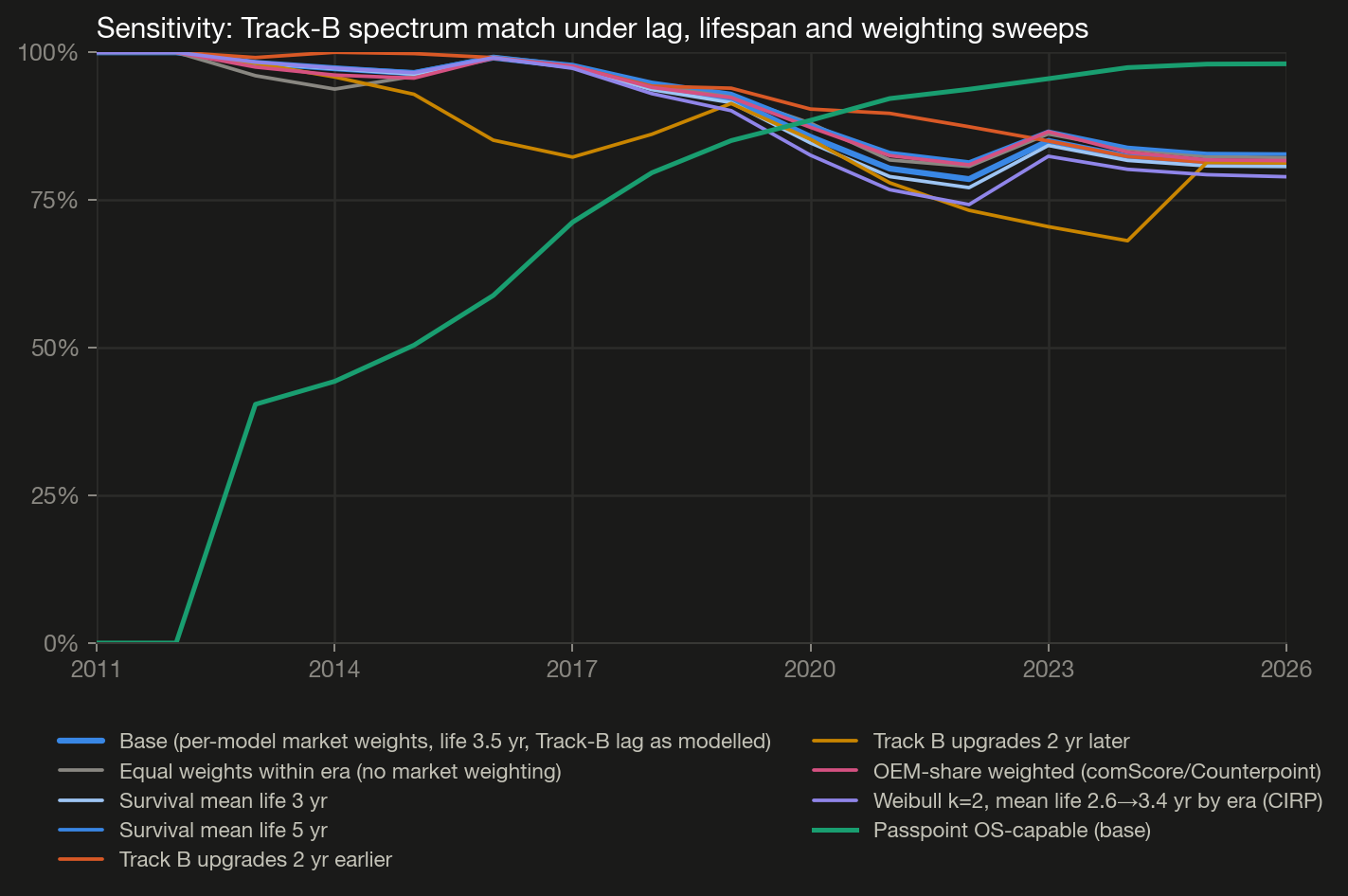
| Scenario | Data-readiness crossover (Passpoint-capable > Track-B spectrum match) | Voice-readiness crossover (Wi-Fi Calling > spectrum match) | Track-B spectrum match 2015 / 2021 / 2026 | Lowest year | Voice-ready 2026 |
|---|---|---|---|---|---|
| Base (per-model market weights × exponential survival, mean life 3.5 yr) | 2020 | 2024 | 96% / 80% / 81% | 79% (2022) | 88% |
| Equal weights within era (former base; no market weighting) | 2021 | none | 96% / 82% / 82% | 81% (2022) | 79% |
| Mean life 3 yr | 2020 | 2024 | 96% / 79% / 81% | 77% (2022) | 90% |
| Mean life 5 yr | 2021 | 2025 | 97% / 83% / 83% | 81% (2022) | 84% |
| Track B upgrades 2 yr earlier | 2021 | 2024 | 100% / 90% / 81% | 81% (2026) | 88% |
| Track B upgrades 2 yr later | 2020 | 2022 | 93% / 78% / 81% | 68% (2024) | 88% |
| OEM-share weighted only (comScore 2012–16, Counterpoint 2017–26; Tier-3) | 2020 | 2025 | 96% / 83% / 82% | 81% (2022) | 85% |
| Weibull k=2, mean life 2.6 → 3.4 yr by era (CIRP; Tier-3) | 2019 | 2021 | 97% / 77% / 79% | 74% (2022) | 93% |
Robust: the data-readiness crossover window (2019–2021), the near-100% served share, and the 2026 spectrum-match level (79–83%). Sensitive: the depth and timing of the trough (68–81%, lowest year 2022–2026), which moves with the Track-B lag — a venue two years slower than typical sits at 68% in 2024, while one two years faster has no trough at all and declines gently to 81%. Weighting moves the two Wi-Fi curves far more than the DAS curve. Market weights lift Passpoint capability from 35% to 50% in 2015 (Apple's 36–44% US share against a cohort with fewer iPhones than Android models) and Wi-Fi Calling readiness from 79% to 88% in 2026, because every iPhone is enabled on all three national carriers while the low-volume unlocked Android SKUs that fail the strict test (Pixel, OnePlus, retail Moto G) shrink to their real footprint; the voice-readiness crossover therefore exists in every weighted case (2021–2025) and in none of the equal-weight ones. The two heaviest brand-share fills in the weights — the LG Stylo 4 and the 2021 Moto G Power, neither with strict Wi-Fi Calling — push the other way, so the 88% is conservative with respect to the weakest weight cells (§10).410
10. Caveats and open items
- Track B has no B30 in any year (typical venues skipped WCS per timeline §3). B30 is 10 MHz of AT&T-only spectrum, so it costs about 1.2–1.3 points of spectrum match in 2026, but it is what moves iPhone 6s/7- and Galaxy S7-class devices from "native" to "partial" in the secondary view from 2016. Recorded as proposal P-B30 in
proposed_track_c_diff.md; not applied. (P-B71 — Track B carrying B71/n71 from 2021–22 — was applied on 2026-09-17 together with the spectrum-match metric.) - Market weights are Tier-3 estimates, and half the devices carry a brand-share fill. Per-model US sales shares are published only for the top sellers (Counterpoint US top-5/top-10 monthly and quarterly tables, Kantar), so 35 devices have a direct launch-window reading, 2 a carried or traffic-converted one, 13 a model-mix chain, and 50 an OEM-share fill split equally across the OEM's cohort devices in that era. A brand with a single cohort device in an era hands that device its entire share: the LG Stylo 4 (14.8% of 2016–19 weight), the 2024 Moto G Power 5G (11.3%), the 2021 Moto G Power (8.8%), the LG Optimus S (7.1%) and the two BlackBerrys (8.0% each) are the cells most likely to be wrong, and all are flagged in
analysis/model_weights.csv. Pre-2011 launch windows are unobservable (iPhone 3GS understated; iPhone 4 GSM/CDMA split 50/50 by assumption); the Galaxy S6 rests on a launch-quarter Kantar reading that is a floor; the DeviceAtlas traffic-to-sales constant spans 1.3–6.3 and affects two devices. Brand-share denominators mix Kantar/NPD sales shares with comScore subscriber shares (conflicts C-MWMERGE-01..09). Theunweightedandoemwscenarios bracket the effect (§9): 79–88% voice-ready in 2026, data crossover 2020–2021, voice crossover 2024–2025 or none. 43 of the 100 cohort rows are archetype fills rather than cited best-sellers (cohort_selection.csv). - Nine band-flag adjudications remain open (
qa/phase3_summary.md§5/§7): S24 base n77, A16 5G B14/n77, Galaxy J3 B30, A10e B14/B30, S7 B13/B17, Pixel 3 B30, Moto G3 700 MHz, iPhone 6 Plus B13, Prevail 2G. None moves the crossover year. - FCC grant dates from grantee listings are upper bounds on first appearance (C-merge-02); two Corning FCC-row passband cells are envelopes — one spans a 3550–3700 CBRS hole, one includes an edge granted after the row's snapshot date — and FCC-row edges are transmit ranges, not DL+UL envelopes (both C-QAE-07).
- "DAS passes the band" ≠ "carrier feeds it." Scoring treats a passed band as fed; a plant passing B5 UMTS after 2022 is passing dead air and is scored as such via
techs_served. - Passpoint enablement is unmeasured; the OS-capable (data) curve is an upper bound on what a venue could enable.
- Wi-Fi Calling dates are floors and ceilings, not points. Carrier support pages were often first archived years after the device shipped (T-Mobile's bulk crawl of Feb-2020; Verizon's 2020–21 archive floor; AT&T's sparse archive), so support is dated from max(release, carrier launch) with the capture kept as an upper bound. Two cells rest on community reports plus a carrier blanket statement (Tier 3, marked probable). Five devices are unsourced and count as not voice-ready, so the 88% is a floor (
qa/wfc_support_summary.md, conflicts C-WFC*).
11. Conflicts
conflicts_log.md holds 223 append-only entries; qa/conflicts_triage.csv classifies the 98 that existed at the start of QA (37 gaps, 22 adjudications, 22 closed, 15 real per-SKU splits, 2 process) and conflicts.md lists the open adjudications. Rule 2 of CLAUDE.md applied throughout: no disagreement was silently resolved.
12. Deliverables
handset_das_passpoint_dataset.xlsx (cohort, timeline, evidence, scores, curves, selection, QA) · das_capability_timeline.md + das_timeline.csv · das_passband_evidence.csv · report.md (this file; Typora → PDF) · conflicts.md · exec_onepager.md · analysis/bibliography.md (631 cited URLs grouped by host, plus the timeline's S1–S41 and [E] sources).
-
analysis/curves.csv, scenariobase, track B unless stated; columnsspectrum_match,served,native…unserved,pp_*; produced byscripts/score.pyfromdevice_cohort.csvanddas_timeline.csv. ↩↩↩↩↩↩ -
qa/wfc_support_merged.csv(per device: OS/IMS support, first archived listing per carrier with URL, SKU carrier scope,own_carriers_year= strict voice-ready year); built byscripts/merge_wfc.pyfromqa/wfc_support.csv, the OEM/carrier re-pass filesqa/wfc_android_{S1,S2,G,M}.csv,qa/wfc_carrier_statements.csvand the Tier-3 corroboration passqa/wfc_tier3.csv; summaryqa/wfc_support_summary.md; conflicts C-WFC*, C-WFCS1/S2/G/M, C-WFCT3. Curve columnswfc_any,wfc_all3,wifidas_ready_strictinanalysis/curves.csv. ↩↩↩↩↩ -
analysis/voice_data_split.csv(year rows: data-ready, voice-ready strict, both, neither, voice path via Wi-Fi Calling or DAS, both-paths share for phones ≤2 years old and older) andanalysis/readiness_by_cohort.csv(release-year rows, unweighted device counts), produced byscripts/voice_data_split.pywith the base-case weights;--unweightedwrites the equal-weight variants. ↩↩↩↩↩ -
analysis/curves.csv, scenariosunweighted,life3,life5,lagB-2,lagB+2,oemw,weibull; chartanalysis/charts/sensitivity.png; side-by-side inscripts/compare_scenarios.py. OEM weights and the Weibull parameters come fromanalysis/weights_sources.csv(Tier-3; see C-P4-01, C-P4-02). ↩↩↩↩ -
das_passband_evidence.csv(321 rows; 311 cite a Wayback snapshot URL with a 14-digit timestamp or an fccid.io grant URL, 10 cite live vendor PDFs or a CDX absence query and are marked as such innotes); synthesis indas_capability_timeline.md§7 and source list [E]. ↩↩↩ -
Installed-base band penetration computed in
scripts/charts.pyfrom cohort flagsb66,b71,n77,b14,n41,b12_13_17with the same market × survival weights as the base case. ↩↩ -
device_cohort.csv(per-rowsourcescolumn: GSMArena page, Apple/Google/Samsung spec page, frequencycheck per-model page, fccid.io grant, WFA record); selection incohort_selection.csv; per-batch provenance inraw/tier2_bands_batch*.csvandraw/apple_bands_batch*.csv. ↩ -
das_capability_timeline.md§1–§3 and sources [S1]–[S41]; Track definitions §1; lag calibration §2; applied revisions inproposed_track_c_diff.md(commits 4eb8009, d3d1a4d). ↩↩ -
Survival mean life 3.5 years is an assumption bracketed by Tier-3 evidence: Counterpoint's 43-month (3.6 yr) replacement cycle for 2022 is a global figure; CIRP's US distribution shows the share of buyers whose previous phone was 3+ years old rising from 26% (2019) to 39% (2026); the US-specific Daniel Research/Statista series is paywalled (
analysis/weights_sources.csv,analysis/weights_sources_notes.md; C-P4-02). Swept 3–5 years and as a Weibull with era-varying mean in §9. ↩ -
analysis/model_weights.csv(device × year weight, basis, share estimate, sources, note) built byscripts/build_model_weights.pyfromanalysis/model_weights_sources_{CP,EARLY,IOS,AND}.csv(627 Tier-3 rows: Counterpoint, Kantar, NPD, comScore, DeviceAtlas, StatCounter) andanalysis/weights_sources.csv; method and reviewer items inanalysis/model_weights_method.md; conflicts C-MW*-nn and C-MWMERGE-01..09. Adopted as the base case 2026-09-21; the equal-weight case is retained as scenariounweighted. ↩↩ -
Pinned Passpoint facts (CLAUDE.md rule 5): iPhone R1 uncertified; WFA removed R2 in 2023; R3 = Android 12+; Passpoint required in AOSP from Android 11; OEM-disable window 2015–2020. Sources [S30]–[S32] and
phase0_recipe_and_findings.md§3. ↩ -
qa/wfa_cert.csv— Wi-Fi Alliance Product Finder (prf.cert.wi-fi.org) queries by OEM model number, 69 Android rows, certificate PDFs cached underraw/wfa/; summary entry C-QAW-01 inconflicts_log.md. Apple non-certification and the 2023 R2 removal: timeline sources [S30]–[S32]. ↩